
GLOBAL LOGISTICS / 8 MIN READ
Shopify HS Codes and Country of Origin: A China 3PL Customs Handoff Checklist
Keep Shopify HS codes, country of origin, variant identity, and order-level customs facts aligned before a China 3PL creates an international label. Includes a practical handoff schema and market-specific review checklist.
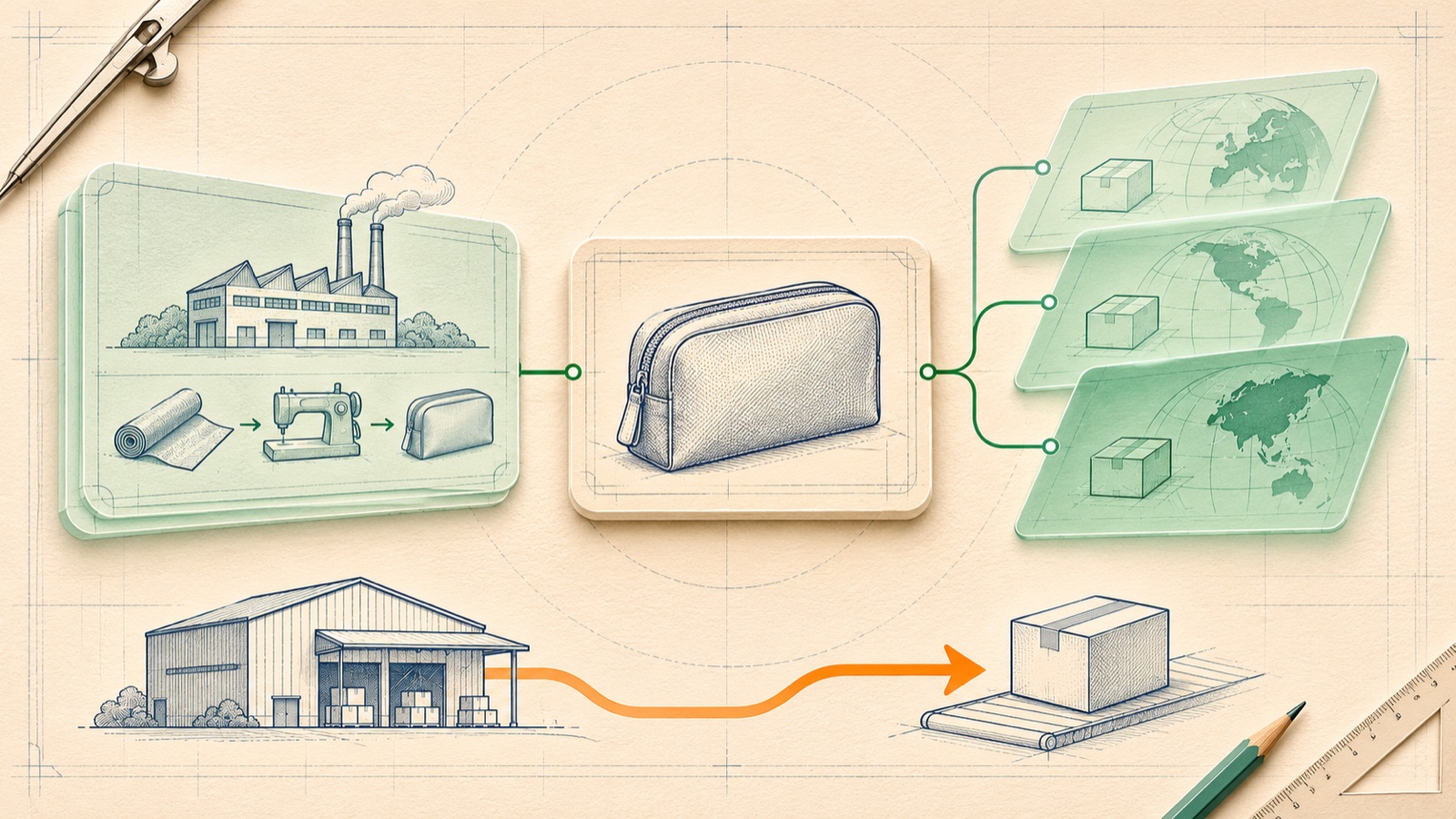
A parcel can leave a warehouse in China without the product’s customs origin automatically being China. The dispatch address answers where this parcel starts moving; country of origin is a product and trade-rule question. Shopify’s HS code and origin fields become part of a declaration workflow, so a convenient default can quietly turn into a repeated data error.
For a Shopify brand using a China sourcing partner or 3PL, the practical job is to give each variant a supportable customs record, keep destination-specific classification separate, and pass the same approved data into the fulfillment handoff.
What Shopify needs for an international customs declaration
Shopify says a customs declaration created with a shipping label is built from product and order details. For each item that needs a declaration, its documentation lists an HS code of at least six digits, country or region of origin, goods description, quantity, value, and item weight. Missing information can prevent label creation; saved product details can be reused on later international labels. See Shopify’s customs documentation guide.
That list contains different kinds of facts:
- Product identity: what the item is, how it is made, what it is made from, and which Shopify variant/SKU is being sold.
- Classification: the HS code used to classify that product for the relevant customs process.
- Origin: the origin determined under the destination’s applicable rule, supported by manufacturing facts.
- Shipment facts: quantity, declared value, description on the declaration, and item weight for this order.
Shopify is the place to store and reuse fields. It does not make every customs decision for the merchant, carrier, importer, or customs authority.
HS code: six digits are a shared starting point, not every country’s final code
The World Customs Organization describes the Harmonized System at the international six-digit subheading level. National tariff schedules can add subdivisions beyond that level, and the WCO says final import or export classification follows the relevant national schedule. Shopify likewise explains that countries can add digits after the first six and supports country-specific HS codes for markets where that detail is needed. Shopify’s HS-code setup guide explains the product, bulk-editor, and CSV workflows; the WCO HS FAQ explains the international/national distinction.
Operational implication: do not treat one code copied from a supplier listing, an old invoice, or an online marketplace as a permanent universal answer. Keep the supported six-digit baseline and any required destination-specific extension as separately traceable values. A short title like “travel bag” is not enough to establish a classification: construction, material, function, and the importing country’s schedule can matter. If the classification is uncertain, obtain a documented review from the appropriate customs broker or authority before using it on live declarations.
Country of origin is not the ship-from country
Shopify’s product details describe origin as the country where a product was manufactured or assembled, while noting that rules differ by country and international agreement. In the EU, for example, the Commission describes wholly obtained goods and, for multi-country production, last substantial transformation under EU rules. That is an EU-specific explanation, not a universal test for every destination. See the Commission’s non-preferential origin guidance.
Keep these fields conceptually separate:
• Fulfillment location / ship-from: Answers where the order will be packed or dispatched. Keep the Shopify location and warehouse-routing record. • Country of origin: Answers what origin the applicable trade rule assigns to the product. Keep manufacturer details, production steps, material and assembly records, and a destination-specific review. • HS code: Answers how the product is classified under the applicable tariff schedule. Keep the product specification and classification source/review. • Ship-to country: Identifies which destination rules and national code extensions may apply. Keep the customer order and market setting.
A product stored in a China 3PL may have been manufactured elsewhere. Conversely, a product that ships from another warehouse does not become a product of that warehouse’s country merely because it is dispatched there. Do not copy a warehouse country into origin just to fill a blank. Shopify’s default origin is a fallback for products without an assigned origin; an explicit product value takes precedence. Review defaults before activation, especially when the catalog has multiple manufacturing countries.
Build a variant-level customs data handoff
Use one controlled record per sellable variant, or another level only if the product, material, origin, and classification truly remain identical. A practical data sheet can include:
• Shopify product/variant ID and merchant SKU: The merchant records a stable store identity and avoids title-only matching; the 3PL keeps the same identifiers on imports and exception reports. • Plain-language goods description: The merchant records specific product type, intended use, and distinguishing material/construction facts; the 3PL receives declaration-ready wording rather than marketing-only copy. • HS code: The merchant keeps the supported six-digit code and its source/reviewer; the 3PL receives the base code plus a destination-specific extension where required. • Country/region of origin: The merchant records the approved value and production basis; the 3PL receives that approved origin, not a warehouse address. • Evidence and owner: The merchant logs supplier/manufacturer statements, process summaries, source documents, reviewer, and review date; the 3PL has a way to flag missing, changed, or disputed data before label creation. • Order-level facts: The merchant records where quantity, value, and current weight come from; the 3PL receives the order-line values and flags exceptions needing merchant confirmation.
This is an operational schema, not a substitute for an official customs dataset. Keep a change log: who changed a classification or origin, what evidence was used, which markets were reviewed, and when the record should be checked again. A supplier’s answer is evidence to assess, not automatically the final legal determination.
A hypothetical handoff example
Imagine a store sells a fabric pouch and a metal desk accessory. Both are packed at the same China 3PL. Their ship-from location is the same, but their material, construction, manufacturer, and classification questions are not. The merchant therefore maintains separate variant records, asks each manufacturer for production facts, verifies each product’s classification for its target markets, and sends the 3PL two correctly matched records. No HS code or country of origin can be inferred from this example. It illustrates why “same warehouse” is not a safe reason to reuse customs fields.
Put Shopify and the 3PL on one controlled path
- Collect product facts before assigning codes. Request a precise product description, material breakdown where relevant, manufacturing/assembly location and steps, variant/SKU mapping, net item weight, and any existing customs classification or origin evidence.
- Review classification and origin for the destination markets you sell to. Use the current national tariff schedule and the applicable origin rule; get qualified help where product facts or rules are ambiguous. Do not promise a duty amount from the code alone.
- Store the approved values in Shopify. Shopify supports product-level editing, bulk editing, and a duties-and-import-taxes CSV workflow for HS codes and origin. Do not confuse that customs-data CSV with an inventory file used to update other inventory fields. See adding HS codes to products.
- Define the transfer field map. Agree which Shopify variant/SKU and customs fields populate the 3PL or label system; document allowed formats, blank-field behavior, and who can edit after import.
- Test a real route before scale. Review a draft declaration for a representative product and destination. Compare the Shopify product record, the 3PL import, the carrier declaration, and the final label. Stop if any item’s description, origin, code, quantity, value, or weight changes unexpectedly.
- Recheck when the product changes. A new material, assembly step, supplier, bundle, or destination can make an old record unreliable. If you use Shopify Managed Markets, review its applied codes; Shopify notes that assigned codes may not match the code you entered exactly.
Copyable brief for a sourcing partner or 3PL
Variant/SKU:
Product description, materials, and intended use:
Manufacturer and production/assembly steps:
Shopify HS code and source/reviewer:
Destination-specific code extensions, if applicable:
Approved country/region of origin and supporting evidence:
Item weight and order-level quantity/value source:
Shopify field → 3PL/carrier field mapping:
Who places a hold when data is missing or conflicts?
Who approves and records a change before label creation?
For related workflows, see the Shopify DDP vs DAP guide, the China 3PL SKU and barcode mapping checklist, and China sourcing services. To discuss a handoff, share your destination markets, product/variant file, known manufacturer facts, and label workflow through the contact page.
Research note: Shopify and customs-source links checked 25 November 2026. This article is operational guidance, not a tariff classification, origin ruling, customs-broker opinion, or duty estimate. Rules vary by destination and product; confirm live declarations with current official sources and qualified advisers.