
GLOBAL LOGISTICS / 8 MIN READ
Shopify Dropshipping Returns from Overseas: Choose the Right Return Route
A practical framework for Shopify sellers to choose between refund without return, local receipt, regional consolidation, and return to the source country.
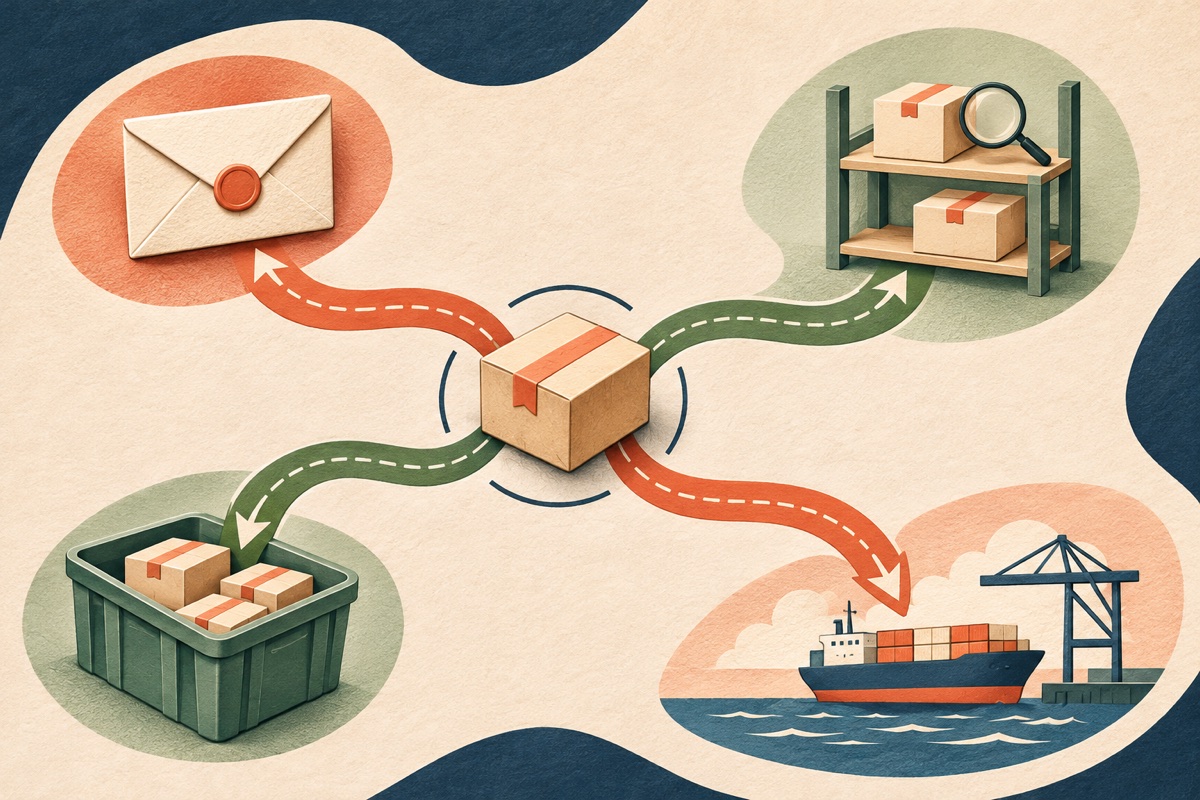
An international return is not just a parcel traveling backward. It is a decision about where the item can be inspected, recovered, resold, exchanged, or safely closed out. If every customer is told to send every product back to China, the return freight and handling can cost more than the item is worth. If every order is refunded without a return, you may lose stock that could have been recovered. The right route depends on the product, destination, condition, value, and your operating setup.
We call this the Four-Route Return Matrix: choose among a refund without physical return, local receipt, regional consolidation, or return to the source country. This is an operational planning framework, not a Shopify feature, legal rule, or promise that any location or service is available.
First, distinguish a refund from a physical return
A refund changes the money returned to the customer. A return records that goods are coming back and lets the merchant manage the received item. Shopify supports returns and exchanges from the Orders area; return workflows can include shipping instructions or labels, inspection, a refund, or an exchange. Shopify also allows a refund without creating a return. Its documentation cautions that once a refund has been issued, you can't create a return afterward. If the customer is actually sending the item back and you need to track its reason and receipt, create the return before issuing the refund.
That distinction matters for dropshipping. “Refund approved,” “return label sent,” “parcel received,” “item inspected,” and “stock available again” are separate events. Your customer service team and fulfillment partner should use the same event names so that an order is not marked recoverable before anyone has seen the product.
The Four-Route Return Matrix
| Route | Use it when | What must be ready | Main trade-off | | --- | --- | --- | --- | | Refund without physical return | Return freight and handling would exceed likely recovery value, or the item cannot be resold safely | A documented decision, the correct refund flow, and a customer-facing explanation consistent with your policy | Fast closure, but no returned item to inspect or recover | | Local receipt | The item may be resold or exchanged in its destination market | An authorized local address, receiving instructions, inspection criteria, and a route back into sellable stock | Better access to the item, with local receiving and storage work | | Regional consolidation | Several returns can be held and reviewed together before a cross-border move | A named consolidation point, item-level identification, holding limits, and a decision date | Can reduce one-off handling, but adds time, storage, and batch coordination | | Return to source country | The item has enough recoverable value, needs source-side repair or inspection, or has a defined reuse path there | A confirmed return address, carrier and customs paperwork, product classification, and an owner for the received goods | Direct source-side recovery, with international freight and border steps to verify |
These are possible operating patterns, not services automatically provided by Shopify or DropFillShip. Confirm the physical address, receiving scope, product restrictions, cost, and processing time with the party that will handle the parcel before publishing an address to customers.
Use a recovery calculation, not a one-size-fits-all rule
For each product and destination, estimate the value you can actually recover after the return arrives:
Net recovery = resale or reuse value − return label − receiving and inspection − storage or consolidation − onward shipping − repair or repacking − applicable duties and fees
The terms in the formula are decision inputs, not universal charges. Use actual quotes and your own records. Some products cannot be resold as new after opening; others may be inspected, repacked, exchanged, used for parts, or safely disposed of. A local warehouse does not make recovery automatic: the item still needs an owner, a condition grade, a stock disposition, and an accounting update.
Compare the result with the refund or replacement path that your policy permits. If a physical return has negative or uncertain recovery value, a refund without return may be operationally reasonable when it is allowed by your policy and applicable consumer rules. If recovery is positive, compare the local route, consolidation route, and source-country route. Recheck the calculation when destination, service, product value, packaging, or return condition changes.
A simple example can be calculated without inventing a benchmark. Suppose a merchant has recorded the expected resale value as V, the return transport quote as L, and receiving plus inspection as H. The first local estimate is V − L − H. If that figure is positive, add any storage, onward shipping, repacking, duties, and payment effects before choosing the route. If the inputs are unknown, record them as unknown and request a quote; do not replace them with a guessed “typical” cost.
What Shopify can and cannot arrange for a return
Shopify's return tools help manage the return record, customer instructions, eligible return rules, refunds, and exchanges. They do not determine which country should physically receive the parcel. That location must match your actual merchant and fulfillment arrangement.
Shopify's built-in return-label purchase has a defined geographic limit: the return-label documentation says merchants shipping from a fulfillment location in the United States or Canada can buy labels in Shopify, and the labels are for domestic US or domestic Canadian returns. It says international return labels aren't available through that built-in flow; merchants can obtain a label from a carrier, a third-party service, or an app. Verify current eligibility in your own admin before promising a Shopify-generated label.
Shopify return rules can specify a return window, return shipping cost, restocking fee, and final-sale items. Those settings do not replace a written, visible policy or local legal requirements. Policies differ by market and product, and legal obligations can override a store's preferred workflow. Ask qualified local counsel about obligations for the countries where you sell; this article is not legal or tax advice.
Make the receiving handoff operational
Before a return address goes live, agree on a small receiving specification with the warehouse or service partner:
- Address and authorization: Confirm that the location accepts customer returns for your business and the relevant product types. Don't publish a partner's address without written permission.
- Identification: Require an order number or return authorization, SKU, quantity, and customer-selected reason. Use a durable label or insert that remains with the item.
- Condition grades: Define sellable, open-box, damaged, incomplete, and unknown. Add photos for exceptions and set who approves a refund or replacement.
- Decision deadline: Set when an unreviewed parcel is escalated and how long it may be held before the next disposition.
- Stock and finance: State who can restock, quarantine, exchange, write off, or dispose of goods, and how Shopify inventory and the refund record are updated.
- Exceptions: Decide how to handle refused parcels, missing items, prohibited products, customs requests, and returns with no matching order.
A return address is not a returns process. If the warehouse cannot inspect, segregate, and report items, sending parcels there may only move the problem to another shelf.
Copyable return-route brief
Use this internally before approving a route:
- Order and SKU:
- Destination market and original fulfillment location:
- Customer-reported reason and photos:
- Item state: unopened / opened / damaged / incomplete / unknown:
- Policy and eligibility checked by:
- Expected recovery value and source of estimate:
- Return label and transport quote:
- Receiving, inspection, storage, and onward costs:
- Candidate route: refund without return / local receipt / regional consolidation / source-country return:
- Person responsible for the parcel and final inventory disposition:
- Customer update and next review date:
For repeatable operations, review return reasons by SKU and destination. A cluster of damage reports may call for packaging or supplier review; sizing or expectation issues may call for clearer product information. Treat this as a signal to investigate, not proof of a supplier defect or a guaranteed cause.
A practical launch checklist
- Publish a return policy that matches your actual destinations and operating capacity.
- Confirm an authorized receiving point for each market where you accept physical returns.
- Test the Shopify return flow and make sure the return record is created before any refund when the item is coming back.
- Verify which return-label method is available for the customer's origin and destination.
- Define inspection grades, inventory actions, escalation time, and exception ownership.
- Compare the four routes with recorded product values and real transport or handling quotes.
- Review the workflow when you change a fulfillment location, supplier, product, market, or return policy.
Related: DropFillShip cross-border delivery, coverage information, and contact the team. If you want to evaluate a return workflow for a product, share its SKU, destination markets, parcel profile, expected return volume, and the inspection or resale steps you need. The team can confirm which parts fit the available operating setup.
Source notes (accessed November 9, 2026): Shopify returns and exchanges; creating returns and exchanges; return and cancellation rules; buying return labels. Feature availability and policy obligations should be checked for the current store, market, and product.