
SOURCING & GROWTH / 9 MIN READ
China Purchase Order Template: Turn a Supplier Quote Into a Production-Ready Handoff
Turn an accepted supplier quote into a controlled production handoff. Use ten PO fields to align product specs, packout, release gates, and receiving.
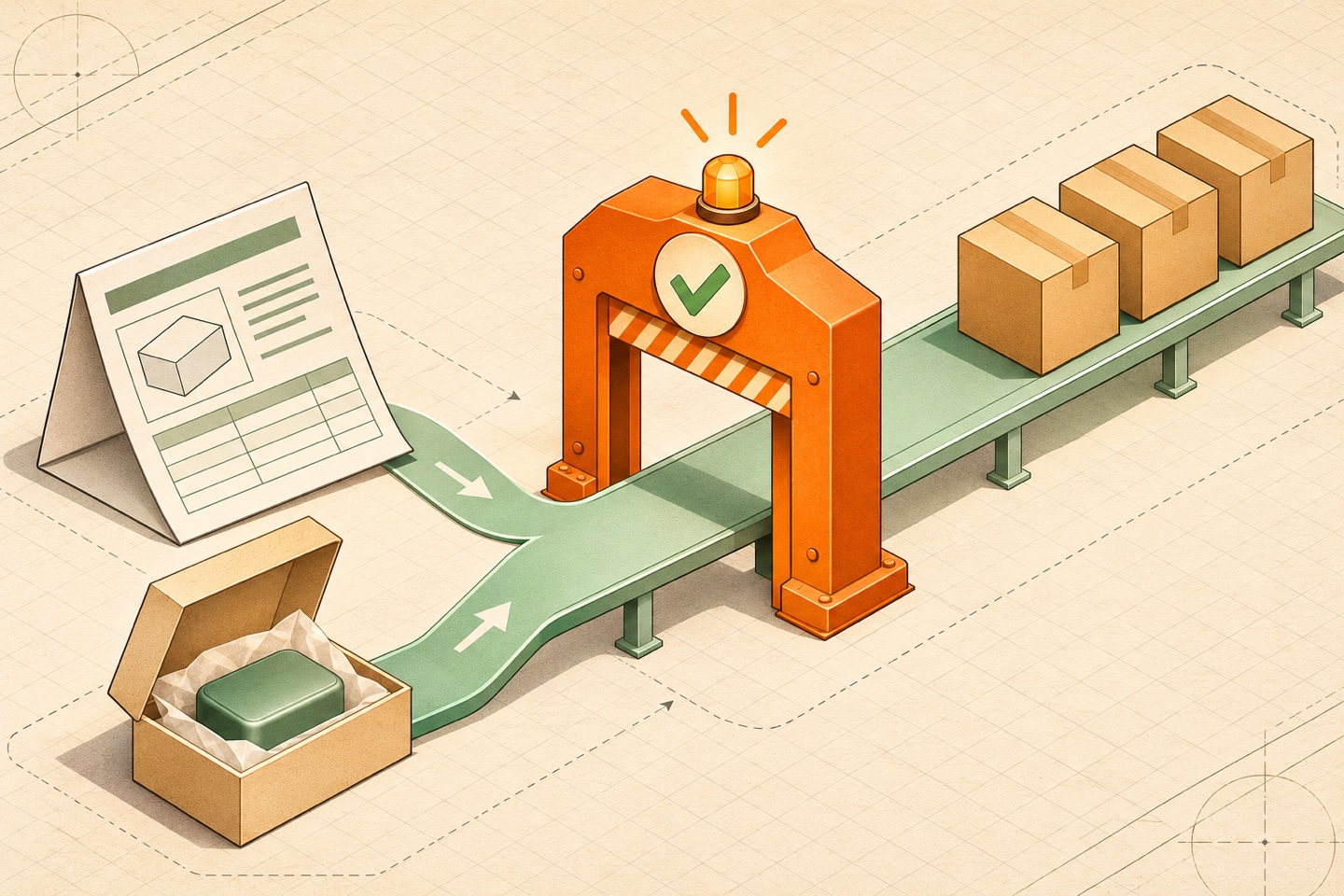
An accepted supplier quote can still leave a dangerous gap: the buyer believes one version of the product is approved, while the factory starts from an older artwork, a different packout, or a message thread with no clear release instruction.
A purchase order should close that gap. It turns an accepted quote into a controlled handoff that names the exact item, specification, quantity, price basis, packaging, schedule, inspection gate, and person who can authorize changes. This guide calls that sequence the quote-to-release bridge. That is an editorial workflow model, not a Shopify feature or legal term.
RFQ, supplier quote, purchase order, and production release
These records answer different questions:
- RFQ: What products and conditions are you asking suppliers to quote?
- Supplier quote or pro forma invoice: What price and terms is the supplier proposing? In documentary-credit guidance, the ICC describes a pro forma invoice as a quote; the document's meaning still depends on the transaction and its terms.
- Purchase order (PO): What exact scope is the buyer recording as ordered, including supplier, item, quantity, price, and payment terms?
- Production release: Has the factory received written approval to start this version of the job?
- Inventory receipt: What physically arrived, what passed the buyer's receiving decision, and what remains outstanding?
A PO is not automatically a complete manufacturing contract. A Shopify PO is an inventory record; it does not decide governing law or replace the parties' signed terms. Treat supplier confirmation and the approved specification as part of the handoff.
Shopify's current help documentation describes its purchase orders as records for supplier agreements, products, prices, quantities, supplier details, inventory cost, and payment terms. A PO can be saved as a draft, exported as a PDF for supplier review, and marked Ordered after supplier confirmation. Receiving and partial receipt happen on a linked inventory transfer, which tracks the physical movement separately. That separation is useful even if your supplier and fulfillment partners use their own systems.
The 10 fields that make a China supplier PO executable
1. PO number, issue date, and revision
Give every PO a stable identifier and revision, such as CDG-2611-014 / Rev 02. Reference the exact supplier quote number and revision it accepts. If a price, color, artwork, or carton pack changes, issue a new revision and identify what it replaces. Do not let a later chat message silently become the production master.
2. Buyer and supplier identity
Name the legal or trading entities used for the order, their operating contacts, and the person authorized to approve the PO. If the factory, trading company, and payment beneficiary differ, record each role explicitly and resolve the mismatch before paying. This is an internal verification step, not a substitute for due diligence.
3. Product and variant identity
Include your store SKU, supplier SKU, product name, color, size, material, and variant. Add a barcode or GTIN only when the product actually has one. A photo alone is a weak identifier when two variants look similar. For a multi-variant order, state each line separately.
4. Controlled specification and approved sample
Name the specification file, drawing, artwork, or sample revision being purchased. Record measurable attributes that matter: dimensions and tolerance, material, finish, color reference, included accessories, and any test or labeling requirement. Point to the approved sample or signed sample record by date and version. If an attribute is not defined, mark it as open rather than relying on “same as sample” without identifying which sample.
5. Quantity, unit of measure, and permitted variance
State units per SKU and the unit of measure: pieces, sets, pairs, or cartons. If the supplier may overproduce or underdeliver, state the allowed range and how the final invoice is calculated. If no variance is accepted, say so. Avoid treating a carton count as a unit count; show both when it helps receiving.
6. Price, currency, and cost basis
Show unit price by line, currency, tooling or sample charges, discounts, taxes if applicable, and what is excluded. If shipping, duties, or destination charges are not known when the PO is issued, do not bury them in a vague “all-in” number. Agree how later shipment costs will be documented. Shopify's PO flow allows shipment-level adjustments for costs such as shipping and duties on its linked transfer; this is a bookkeeping option, not a promise that every cost is automatically included.
7. Packaging, carton packout, and labels
List each inner pack and master carton quantity, carton dimensions or weight when already confirmed, barcode placement, suffocation or warning labels where applicable, and whether the product ships retail-ready. Attach the final packaging artwork version. If packaging is being sourced separately, say whether the supplier must wait for it or can produce the product first.
8. Schedule, milestones, and shipment plan
Use dates for milestones that can be checked: sample approval, material readiness, production completion, inspection, and handover to the carrier. Separate the factory-ready date from the estimated delivery date. If a shipment can be split, specify whether the supplier needs approval before splitting and how each shipment will be identified. A date in a PO is a planning commitment to confirm with the supplier, not proof that the goods have shipped.
9. Quality gate and nonconformance path
Name who inspects, what record is used, and what happens if a lot fails. For example: hold release; photograph and identify the affected SKU or carton; record accepted, rejected, and unshipped quantity separately; assign a decision owner and response date; then document rework, replacement, credit, or approved deviation. Use a sampling plan or acceptance criteria agreed for the product; do not invent a universal tolerance or inspection threshold.
10. Payment, release authority, and change control
Write the deposit and balance triggers, the documents needed before payment, and who can approve production release or a substitution. If an approved sample, artwork, or supplier quote changes, require the new version to be acknowledged before the factory proceeds. Keep change approval with the PO revision so receiving can compare what arrived with what was approved.
A worked receiving reconciliation
Hypothetical example: one PO orders 300 units. The supplier plans two shipments of 150 each. The first shipment contains 148 accepted units and 2 rejected units; the second contains 150 accepted units.
The closeout is: 300 ordered = 298 accepted + 2 rejected + 0 outstanding. The rejected two units should have a reason, photo or inspection record, and an agreed owner for replacement, rework, or credit. Do not increase sellable inventory for rejected pieces just because the supplier's packing list says 300 shipped.
Shopify's linked-transfer workflow separates the PO from the physical movement. Its documentation says accepted items become available at the destination, rejected items do not add to available quantity, and items that were never shipped can be canceled. Multiple shipments can be received individually. This makes the reconciliation useful for a single warehouse or a 3PL handoff: compare the PO, carton labels, receiving record, and supplier invoice line by line.
A copyable quote-to-release block
Use this short handoff with your own purchase order or supplier system:
- PO number / revision / date:
- Supplier quote number and revision accepted:
- Buyer / supplier / production contact:
- Store SKU / supplier SKU / variant / barcode:
- Specification and approved sample version:
- Quantity and unit of measure by variant:
- Unit price / currency / taxes / excluded charges:
- Packaging, carton packout, artwork revision:
- Sample approval / production / inspection / handover milestones:
- Shipment split rule and destination:
- Inspection evidence and failed-lot decision owner:
- Deposit / balance trigger / release approver:
- Change log and supplier acknowledgment:
If a supplier cannot confirm an item yet, leave it open with an owner and a due date. A blank field that is visible can be resolved; an assumption hidden in a file often becomes rework.
How the Shopify record fits the handoff
Shopify's purchase order feature requires suppliers, receiving locations, and inventory tracking to be configured for the products. The PO captures the order scope; after supplier confirmation, its status can be marked Ordered. Shopify says that transition cannot be reversed, so verify the supplier, products, costs, and terms before changing the status. The related inventory transfer then tracks shipment and receiving.
This workflow is optional for merchants whose supplier or ERP system is the source of truth. If you use it, use the same SKU mapping and quantities as the supplier-facing PO; do not create one set of identifiers for the factory and another for the warehouse. For receiving and storage context, see our China 3PL inventory receiving checklist, and for supplier discovery see our China sourcing service.
When you ask a China sourcing or fulfillment partner to review a PO handoff, share the target market, product and variant list, approved sample/specification, packaging plan, shipment destination, and desired release milestones. You can contact the CDG team with that brief.
Reader question: Which PO field causes the most back-and-forth in your workflow: the approved sample version, packout, release date, or receiving disposition?
Sources and scope
- Shopify Help Center, Creating and managing purchase orders, accessed 14 November 2026.
- Shopify Help Center, Receiving inventory from a purchase order, accessed 14 November 2026.
- Shopify Help Center, Inventory and locations, accessed 14 November 2026.
- International Chamber of Commerce, Banking Commission Technical Advisors Briefing 7: Title of Invoice, accessed 14 November 2026. The pro forma distinction cited here is specific to documentary-credit practice.
Supplier commitments, change approval, accepted specifications, payment triggers, and legal effect depend on the actual contract and jurisdiction. This is an operational template, not legal advice or a substitute for a product-specific quality plan.