SOURCING & GROWTH / 8 MIN READ
China Pre-Shipment Inspection Checklist: 12 Checks Before Goods Leave the Factory
A ‘finished’ message is not a release decision. Use this China pre-shipment inspection checklist to freeze the specification, classify defects, agree sampling rules, close exceptions, and brief your 3PL before dispatch.
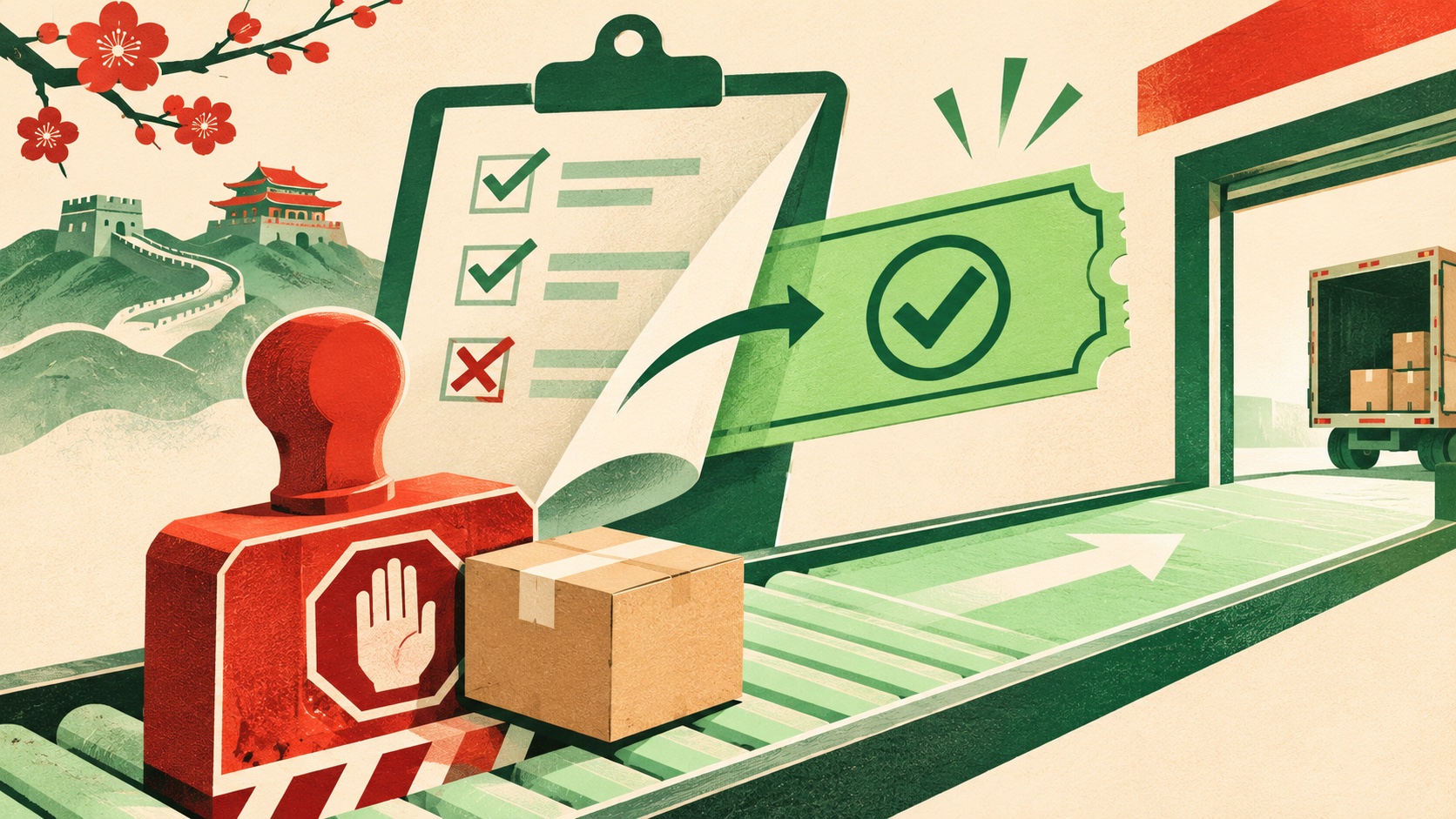
A factory message saying “finished” does not tell you whether the shipment matches the approved product, whether the carton labels are usable, or whether the warehouse can receive it without guessing. A pre-shipment inspection (PSI) is the last practical checkpoint to compare finished goods with a written agreement before they enter international transport.
This guide builds a spec-to-release chain: freeze the inspection basis, define defect decisions, inspect a traceable lot, close exceptions, then send the verified shipment data to your 3PL. It is an operating framework for Shopify brands sourcing from China, not a guarantee that inspection eliminates every defect.
What a pre-shipment inspection can—and cannot—answer
A PSI checks finished or nearly finished goods against buyer-approved criteria before dispatch. Inspection providers describe checks such as quantity, workmanship, function, dimensions, labels, packaging, carton data, and shipping marks. The exact scope depends on the product and the inspection agreement. QIMA describes its own PSI as taking place when at least 80% of an order is complete; treat that as that provider’s service practice, not a universal rule. The practical goal is to inspect when enough finished units exist for a meaningful sample while time remains to correct a problem.
A visual sample inspection is not automatically a laboratory test, product certification, regulatory review, or proof that every unit in the lot conforms. If safety, electrical performance, materials, or destination-market rules require testing or certification, list those separately and confirm who performs them.
Freeze the inspection basis before the inspector arrives
“Match the sample” is too vague unless both sides can identify which sample and which revision. Put the following into one controlled inspection packet:
- Purchase order, product name, SKU, variant, color, and production lot.
- Approved reference sample or dated photos, plus the drawing, BOM, artwork, and specification revision.
- Critical dimensions and measurement method, not just a target number.
- Required functions and a repeatable way to test each one.
- Material, finish, construction, color, and workmanship boundaries.
- Label language, barcode, warnings, inserts, and artwork placement.
- Retail packaging, protective packing, carton quantity, carton marks, and any shipping constraints.
- Defect classes and the agreed acceptance or rejection rule for each class.
If the specification changes after production begins, record the revision and identify which units use it. Do not let an old sample silently become the inspection standard for a revised product.
Define defects in a way two people can apply
Create a photo-backed defect catalogue. A useful starting point is:
- Critical: a defect that may create a safety, legal, or serious compliance risk. Define the stop-and-escalate rule in the purchase agreement; never improvise a safety tolerance at inspection time.
- Major: a failure that prevents normal use, changes the ordered item, or is likely to make the product unacceptable to a buyer. Examples might include the wrong variant, a non-working mechanism, or a substantial construction failure.
- Minor: a small deviation that does not prevent the stated use and stays within a written cosmetic tolerance. “Minor” should not be a catch-all for an issue the buyer has not defined.
Those examples are illustrative. The buyer and supplier must agree what counts for the specific product. For every defect class, show a photo or measurable condition, the inspection method, and the disposition: accept, rework, sort, replace, or hold for approval.
Sampling, AQL, and the decision rule
ISO 2859-1:2026 is the current published edition for attribute-based sampling schemes indexed by acceptance quality limit (AQL) for lot-by-lot inspection. AQL helps define sampling plans and acceptance/rejection thresholds. It is not a promise that each individual lot contains no more than that percentage of defects, and a passing sample does not prove every unit is defect-free. The standard’s sampling plans balance inspection effort and decision risk; choosing a plan is a commercial quality decision, not a substitute for product-specific risk assessment.
Before the order is placed, have the buyer and supplier agree on the lot definition, sampling standard and edition, inspection level, sample-selection method, AQL or other decision criterion by defect class, acceptance/rejection numbers, and what happens after a failure. Use a qualified inspector or quality professional when the product risk or contract requires it. For a safety-critical characteristic, a sampling rule that is appropriate for appearance may be inadequate; specify the appropriate test or 100% check instead.
A hypothetical decision example
Suppose a fictional purchase order contains 300 units of one color and SKU. The inspection brief says the sample must be selected randomly from the finished, packed lot using the sampling plan agreed in the contract. The inspector records each finding by defect class and compares the counts with the agreed acceptance numbers. If a major issue exceeds the agreed limit, the lot is held for the specified correction and re-inspection; the result is not averaged away by a clean carton. The numbers here explain the workflow only; they are not a recommended sample size, AQL, or customer result.
The 12-point China pre-shipment inspection checklist
Ask the inspector to record pass, fail, not checked, or not applicable for each item, with photos and a short explanation for every exception.
- Product identity: correct SKU, variant, model, color, and revision.
- Lot and quantity: finished quantity, packed quantity, and any shortfall or overage reconciled to the order.
- Appearance and workmanship: surface, stitching, assembly, finish, and other product-specific criteria.
- Dimensions and weight: agreed measurement points, units, tolerance, and weighing method.
- Function: the exact operation tested, test steps, sample count, and observed result.
- Materials and components: visible or document-verifiable materials match the approved specification; required lab tests remain separate.
- Labels and compliance information: language, warnings, care details, model identifiers, and placement as applicable to the product and destination.
- Artwork and branding: correct artwork revision, spelling, color, size, and position.
- Accessories and inserts: correct parts, manuals, cables, or inserts in the agreed quantity.
- Retail packaging: correct box or bag, fit, protection, seals, and presentation.
- Export cartons: units per carton, carton dimensions and gross weight, carton condition, and agreed shipping marks.
- Traceability and exception evidence: lot identifiers, sample trace, photos, defect list, inspector conclusion, and corrective-action owner.
This list is a starting point, not a universal checklist. Remove irrelevant checks and add tests for the actual product. For custom packaging, inspect the approved print proof and packaging specification, not a verbal description.
What to do with a failed or incomplete inspection
Use a written disposition path:
- Hold the lot. Do not authorize dispatch while a defined critical or major issue remains open.
- Identify scope. Record affected SKU, lot, carton range, defect class, and whether the cause may affect other units.
- Agree the correction. State who sorts, reworks, replaces, or approves a deviation and who pays under the purchase terms.
- Re-inspect against the same revision. Record whether the re-inspection is full or limited and how it relates to the original report.
- Release only after approval. Keep the report and release decision together with the freight booking and inbound notice.
A conditional “pass” is useful only when the condition, quantity affected, owner, deadline, and release authority are explicit. Otherwise, it can turn into a disputed shipment after the goods have left the factory.
Give your 3PL a receiving-ready handoff
Before dispatch, send the warehouse or fulfillment partner the PO and lot reference, SKU and variant list, approved quantities, carton count, units per carton, carton dimensions and weights, shipping marks, ETA, inspection report, known exceptions, and the person who can authorize a hold or inventory release. Ask the warehouse which labels and advance notice it needs. This connects factory acceptance with warehouse receiving without treating “inspection passed” as proof that the warehouse has counted or released stock.
For related planning, see China sourcing, 3PL warehousing, and custom packaging. If you are comparing a China sourcing and fulfillment workflow, contact the team with the product specification, lot size, destination market, inspection criteria, packaging plan, and receiving requirements.
Copyable inspection brief
- PO / SKU / variant / production lot:
- Approved sample and specification revision:
- Destination market and applicable compliance checks:
- Lot definition and finished quantity:
- Sampling standard / edition / inspection level:
- Defect classes and acceptance numbers:
- Product checks and test method:
- Packaging / label / carton-mark requirements:
- Required report fields and photos:
- Hold, correction, re-inspection, and release owner:
- 3PL receiving contact, location, and pre-alert deadline:
Primary references
- ISO, ISO 2859-1:2026 — Sampling procedures for inspection by attributes, accessed November 12, 2026.
- QIMA, Pre-Shipment Inspection (PSI), accessed November 12, 2026. Provider-specific PSI timing and checklist examples.
- Intertek, Inspection Services for Products & Retail, accessed November 12, 2026.
- SGS, Product Inspection, accessed November 12, 2026.
The spec-to-release chain and copyable brief are original operating frameworks. The 300-unit example is hypothetical and does not specify a statistical sampling plan. Inspection scope, sampling, legal requirements, and release terms vary by product, destination, contract, and risk; a PSI alone cannot certify regulatory compliance or guarantee defect-free production.